
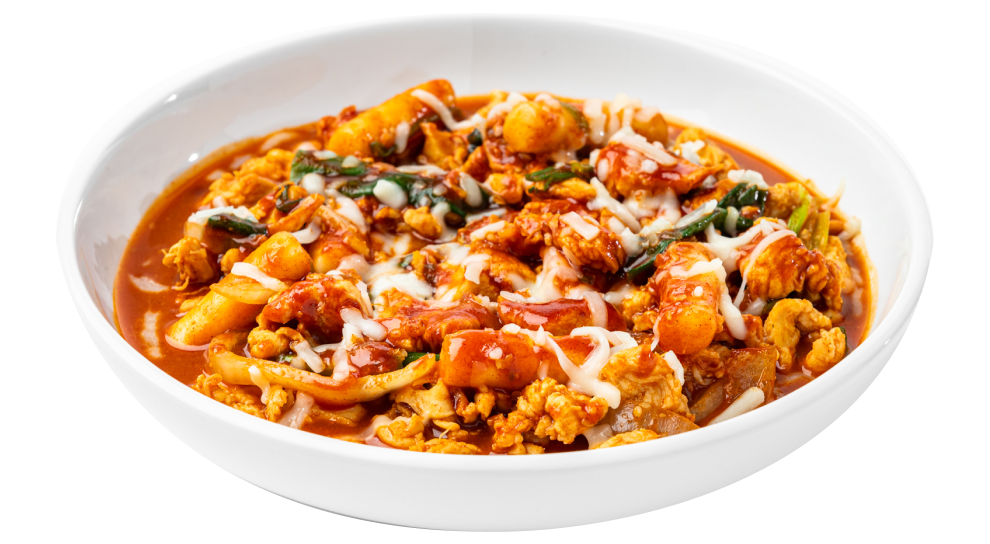
Bonchon Buldak is listed at 2,610 calories
The current June 2026 nutrition data lists Bonchon Buldak at 2,610 calories for the tracked 46-ounce serving. That is the direct answer to the Bonchon Buldak calories question when the restaurant order matches the complete row. The figure represents the combined preparation shown by the source, including the spicy chicken, rice cakes, cheese, sauce, and other included components, rather than plain chicken alone.
A 46-ounce label also signals that this is a substantial restaurant dish, not a small garnish or single piece. Use 2,610 calories as a planning reference for the full order and confirm that your local restaurant still offers the same recipe and portion. If your bowl, tray, toppings, or serving size differs, record the closest supported row and describe the result as an estimate.
Do not double count chicken and rice cakes
Buldak combines several ingredients that also appear elsewhere in the calculator. That makes double counting a real risk. If you select the complete Buldak row, do not automatically add a separate chicken serving, Tteokbokki serving, cheese topping, or rice cake estimate for the same plate. Those components are already part of the tracked preparation unless the restaurant documents an additional item.
The reverse is also true. If your local order is a plain chicken item with a separate side of rice cakes, choose the rows that actually match what was purchased. Start with the names and serving definitions on the receipt or menu, then use the calculator to represent each distinct order once. This keeps a high total honest without turning one meal into several copies of itself.
Review the full macro and sodium profile
The tracked Buldak row lists 149g of fat, 215g of carbohydrates, 15g of fiber, 45g of sugar, 99g of protein, and 3,780mg of sodium alongside its 2,610 calories. Those values explain why the dish should be evaluated as a complete meal or shareable preparation rather than described only as “spicy chicken.” The rice cakes and cheese contribute to the overall profile as well.
Macro comparisons are most useful when they use complete rows. A person may compare Buldak with Tteokbokki, Chicken Katsu, Japchae, Udon, fried rice, or a chicken combo, but none of those comparisons should assume that one nutrient tells the whole story. Consider the portion, carbohydrates, fat, protein, and sodium that matter to your own plan, and rely on qualified guidance for medical decisions.
Share the complete dish before estimating portions
Two people splitting the tracked Buldak order evenly would average about 1,305 calories each. Four equal shares would average about 653 calories each. These are arithmetic divisions of one 2,610-calorie row, not official individual servings. A diner who takes more chicken, cheese, or sauce may consume a different fraction than someone who mostly eats rice cakes.
For shared dining, enter the full Buldak order before anyone starts serving. Note how much remains and estimate each person’s share afterward. If leftovers become another meal, keep the remainder tied to the original total instead of entering a second full Buldak row. This is particularly important for a large container that is intentionally ordered for several people.
Build the rest of the table separately
The complete Buldak row does not include separate wings, boneless chicken, strips, combo pieces, fries, potstickers, kimchi, dessert, or caloric drinks. Add those only when they are distinct orders. A large group may pair Buldak with smaller sides, while one diner may treat a share as the main meal. The calculator lets you test both scenarios without hiding the extra items.
It can be useful to compare the complete Buldak total with a different Korean dish before ordering. That comparison is not a judgment about what anyone should eat; it simply shows how a combined preparation changes the table total. Keep the menu page open for category context and the nutrition page available when you need the source document or current update notes.
Verify spice, toppings, preparation, and allergens
Chicken portion, rice cake amount, cheese, sauce, garnishes, cooking method, container size, local availability, and recipe can vary by restaurant or change over time. Review current official nutrition information and the selected local menu before treating 2,610 calories as an exact match. A substitution or limited-time preparation may require a different estimate.
The calorie row is not an allergen or medical-safety guarantee. Dairy, wheat, soy, sesame, spicy ingredients, shared equipment, and cross-contact may matter for a specific diet. Check official allergen guidance and ask restaurant staff when allergies, medical restrictions, spice sensitivity, or strict nutrition targets require current ingredient and preparation details.