
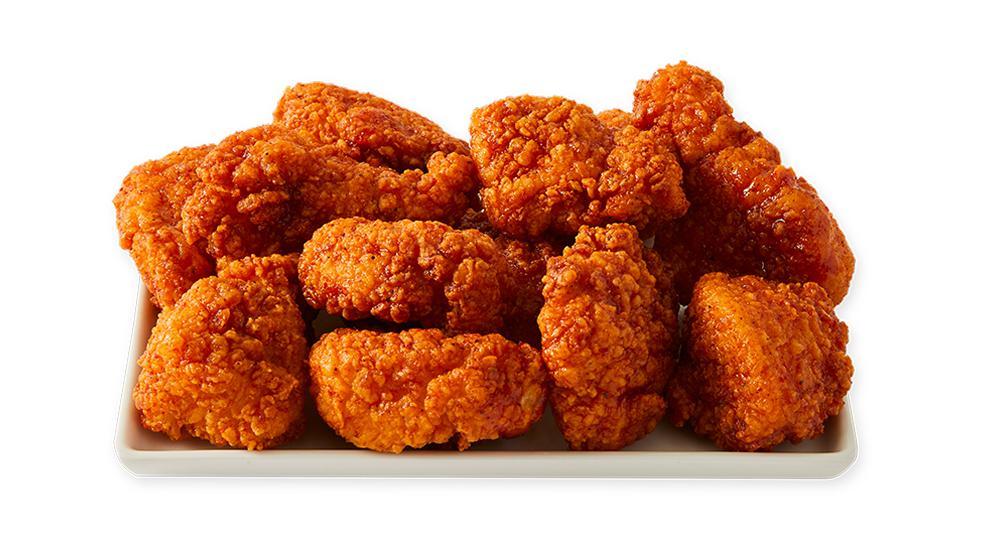
Ten boneless pieces range from 723 to 1,474 calories
The current June 2026 nutrition data lists a tracked 10-piece small Bonchon boneless order at 723 calories for Classic Crunch, 733 for Korean BBQ, 753 for Yangnyeom, 1,473 for Soy Garlic, and 1,474 for Spicy. That makes the practical answer to Bonchon boneless calories a sauce-dependent range rather than one universal number.
Every figure above belongs to a complete 10-piece row. It is not a per-piece estimate and should not be added to a separate chicken subtotal. Match the format, piece count, and sauce shown in the calculator before using a total, because a different order size or preparation can change the result substantially.
Sauce labels must match the exact nutrition row
Classic Crunch, Korean BBQ, and Yangnyeom sit within a narrow 30-calorie span in these tracked small rows, while the listed Soy Garlic and Spicy totals are roughly twice as high. That unusually large separation is exactly why it is safer to use the named source row than to assume every sauce adds only a small coating.
Do not transfer a wing, strip, or drumstick sauce comparison to boneless chicken. Each format has its own breading, portion, meat-to-coating ratio, and tracked serving. If a restaurant offers a split flavor or a count that differs from the source, build the closest supported rows and treat the result as an estimate rather than a measured order.
The complete row matters beyond calories
For the 10-piece rows, Classic Crunch lists 43g fat, 46g carbohydrates, 38g protein, and 2,236mg sodium. Korean BBQ lists 44g fat, 49g carbohydrates, 38g protein, and 1,865mg sodium, while Yangnyeom lists 43g fat, 55g carbohydrates, 38g protein, and 1,700mg sodium.
The tracked Soy Garlic and Spicy rows each list about 84-85g fat, 98g carbohydrates, 170g protein, and more than 3,400mg sodium. Because those values differ sharply from the other sauces, review the entire nutrition line and confirm the current serving instead of choosing only from a headline calorie number.
Count first, then estimate your share
If two people divide a 10-piece Classic Crunch order evenly, the planning average is about 362 calories each before rice, fries, sauces, drinks, or appetizers. The same even split would be about 737 calories each for the tracked Spicy row. Those calculations describe equal halves of the listed order, not official individual servings.
Real shared plates rarely divide perfectly. One person may eat more pieces, choose larger pieces, or take more sauce. A more dependable workflow is to record the full restaurant order, note how many pieces were actually eaten, and then estimate the fraction afterward. Avoid inventing a per-piece value from an order whose count does not match.
Build the rest of the meal around the chicken
Boneless chicken is often only the center of the order. Steamed rice, seasoned fries, coleslaw, pickled radish, potstickers, Korean dishes, dessert, and caloric drinks all need separate entries. Start with the exact boneless row in the calorie calculator, then add each item you expect to eat rather than treating the chicken total as the whole meal.
For a shared table, enter every full plate before dividing the meal among diners. This approach makes it easier to compare a richer sauce with a simpler side, or a lower tracked chicken row with a more substantial appetizer. It also prevents small extras from disappearing simply because they were ordered for the group.
Verify the current portion, recipe, and allergen details
Nutrition data is a planning reference for a standardized restaurant preparation. Actual piece size, breading, frying oil, sauce coverage, substitutions, and local menu configuration can differ. Confirm that your restaurant still offers the same count and flavor, especially when the ordering screen uses a different small, medium, or large serving.
Calories and macros do not establish allergen safety. Boneless chicken, batter, sauces, and shared kitchen equipment may involve ingredients or cross-contact that matter for a specific diet. When accuracy or dietary safety is important, review the current official Bonchon nutrition and allergen information and ask the selected restaurant about its preparation.